Peering Into Ethernet’s Crystal Ball: Predictions for 2026

“2026 is going to be another exciting year for Ethernet. This continues to reinforce how beautiful this technology is,” said Carl Wilson, Ethernet Alliance Board Member and Senior Director of Connectivity at MaxLinear. “Ethernet is everywhere. It’s flexible, it’s extensible, and dare I say it, Ethernet is exciting.”
Few technologies enjoy the kind of staying power that Ethernet has. Yet as AI adoption accelerates and data center demands intensify, Ethernet continues to evolve – often faster than expected – flinging open the doors to new markets and applications.
So, what does 2026 hold for this remarkable technology? Ethernet Alliance leaders and members share their perspectives and predictions about where Ethernet is headed, what’s driving change, and why industry collaboration and interoperability matter now more than ever.
Ethernet: The Backbone of AI
AI reshaped infrastructure planning in 2025, and its impact will only intensify throughout 2026. As it grows, Ethernet is growing alongside it, transforming power, scale, latency, and interoperability from abstract ideas into everyday operational realities. From a broader industry vantage point, the trend is unmistakable…and unstoppable:
AI infrastructure took center stage in 2025 as the scale of the deployments needed and the challenges of those deployments became clear. Proprietary solutions initially dominated in this space, but due to the necessities of the ecosystem, open and scalable solutions are rapidly following. My number one prediction is that Ethernet will be the clear technology winner in 2026. – Mark Nowell, Cisco Fellow, Cisco
In 2026, Ethernet for AI-driven networks won’t just detect packet loss instantly, they might actually even apologize for the inconvenience. – Priyank Shukla, Director of Product Management, Synopsys
Ethernet will continue evolving as the backbone of AI-driven data centers with higher bandwidth and lower latency standards, enabling seamless machine learning workloads and real-time analytics. – Jagdish Kaushik, Senior Principal Engineer, MaxLinear
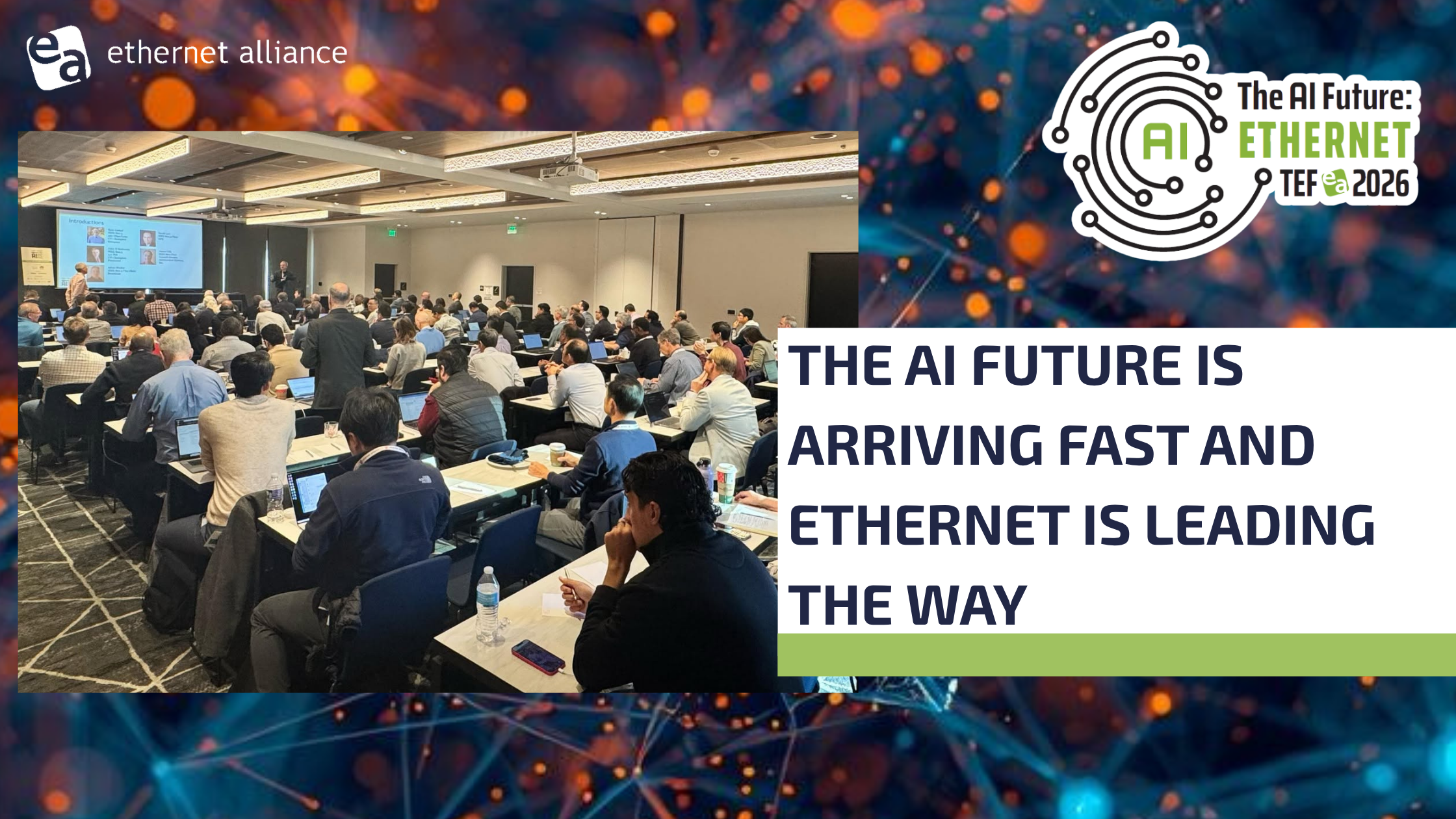
I expect the hyperscale market to make significant technology leaps ahead of ratified global standards. The Ethernet Alliance’s Technology Exploration Forum (TEF 2025): Ethernet for AI showed that there’s an insatiable demand for faster interconnects to support AI and ML’s ravenous appetite. However, once you start connecting things across different physical locations, it quickly becomes clear how important stable, reliable, and interoperable standards-based solutions really are. – David J. Rodgers, Ethernet Alliance President and Events & Conferences Chair, and Technical Business Development Manager, EXFO
The Ethernet industry is facing a period of unprecedented growth, particularly in AI data center networks. It’s going to be AI, more AI, and even more AI. But as I’ve said before, you should never bet against Ethernet. – Peter Jones, Ethernet Alliance Chair, and Distinguished Engineer, Cisco
Collaboration Becomes Non-Negotiable
As AI workloads stretch networks to their limits, it’s clear that no single company or standard can move fast enough to keep up on its own. Real progress depends on working together across the broader Ethernet ecosystem, and that closer alignment is already starting to take shape:
As workloads outpace network capacity, 448G becomes foundational to sustaining competitive data center performance. Closer electrical-optical co-design, channel optimization, and advanced packaging are now essential. Early coordination across OIF, IEEE 802.3, UEC, and hyperscale partners is critical in ensuring viable channels, predictable performance, and a smooth path to 3.2T Ethernet. – Priyank Shukla, Director of Product Management, Synopsys
Beyond IEEE 802.3, the industry is gaining clarity on the different network requirements for building out these massive clusters. Standardization is happening around scale-up and scale-out networks, all coalescing around Ethernet as the Physical layer. – Mark Nowell, Cisco Fellow, Cisco
When Faster Isn’t Fast Enough: The Move to 800G and Beyond
As AI clusters mushroom in both size and complexity, network bandwidth is under almost constant pressure. What felt like a future problem not long ago is now a near-term reality, as network architects push beyond today’s limits to support AI scale-up and scale-out demands:
224G lanes will become the norm, 1.6T links will move from slideware to reality, and Ultra Ethernet will slice through tail latency like a master chef. – Priyank Shuklas, Director of Product Management, Synopsys
Routability, ease of deployment, and cost efficiency are why Ethernet remains the preferred interconnect over other technologies. 800G/1.6T will eventually become the gold standard for AI. The Ethernet Alliance is working hand-in-hand with the Ethernet ecosystem to accelerate the introduction of this new technology, collaborating closely with industry stakeholders to ensure interoperability and a quicker time to market. In 2026, I expect to see a flurry of activity and announcements between customers and industry partners on 800G/1.6T. – Carl Wilson, Senior Director of Connectivity, MaxLinear
Ethernet isn’t slowing down anytime soon – in fact, it’s picking up speed, literally. The IEEE 802.3dj Task Force is still refining the 1.6T Ethernet specification; meanwhile, chatter around 400G electrical signaling for 3.2T Ethernet is growing and getting louder. That overlap says a lot about where the industry is headed. Development cycles are tightening, ambitions are rising, and Ethernet is evolving in lockstep with the demands being placed on it. – David J. Rodgers, Ethernet Alliance President and Events & Conferences Chair, and Technical Business Development Manager, EXFO
Life in the Fast Lane: Automotive Ethernet
As vehicles become more connected and software-driven, Ethernet is making inroads in automotive network design. Momentum is building as automakers shift toward zonal architectures and scalable solutions. In 2026, it’s clearly pedal to the metal for automotive Ethernet:
Although adoption is slower than originally expected, automotive Ethernet is gaining traction as vehicles move from traditional wiring harnesses and a single vehicle computer to the vision of fully connected Zonal compute architectures. We’re starting to see enhancements to Ethernet through new specifications and industry initiatives driven by the automotive industry. For 2026, I expect to see new deployments of Single Pair Ethernet solutions, as well as creative approaches for deploying in-vehicle Ethernet to drive innovation while minimizing costs. – Carl Wilson, Senior Director of Connectivity, MaxLinear
The Ethernet industry is expanding laterally, with automotive Ethernet in particular seeing steady growth. The market is projected to surpass $2.5 billion in 2025 and grow at a CAGR of 15–20% through 2034, underscoring the scale of this opportunity over the coming years. – Peter Jones, Ethernet Alliance Chair, and Distinguished Engineer, Cisco
Ethernet’s role in automotive and industrial IoT will expand beyond 1G to 2.5G speed mode, delivering deterministic networking and robust security for connected factories and autonomous vehicles. – Jagdish Kaushik, Senior Principal Engineer, MaxLinear
Bringing Ethernet’s Future Into Focus
As Ethernet continues to evolve across applications and markets, moving forward isn’t just about innovation, it’s about moving ahead together. The Ethernet Alliance will build on its role as the industry voice of Ethernet by fostering open technical exchange, hands-on validation, and a neutral space where ideas can be explored and put into practice. By doing so, we’re ensuring that Ethernet’s next chapter is not only forward-looking, but ready for what comes next.