The Future of AI Runs on Ethernet: Reflections from OFC 2026

By: John D’Ambrosia, Chair Emeritus, Ethernet Alliance
I had the privilege of moderating the Ethernet Alliance Ethernet’s Accelerating Evolution – Enabling the Expansion of AI panel at OFC 2026, which turned into one of those rare conversations where market reality, technical urgency, and industry ambition collided in real time. In the densely packed room, the questions were sharp and the stakes felt higher than ever – not surprising given AI’s explosive growth.
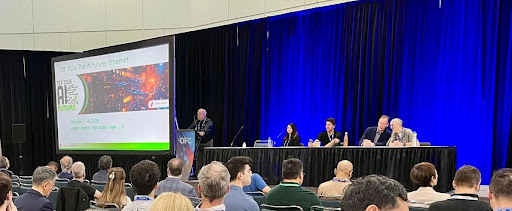
One singular moment truly crystallized the scale of what’s ahead. It came when Dell’Oro Group Vice President Sameh Boujelbeneat highlighted that her half-trillion-dollar Ethernet switching forecast over the next five years is not demand-limited but is instead supply-limited. In other words, the appetite for Ethernet in AI networks is so massive, immediate, and sustained that the only real constraint is whether the industry can build enough switching capacity.
That comment lit a spark.
Suddenly the panelists, representing silicon, optics, systems, and hyperscale operators, moved into a deep discussion of the critical need for multiple, diverse sources of electrical, optical, and switching components. AI back-end networks aren’t just scaling up; they’re scaling out and across. That translates to more links, more bandwidth, more power, more cooling – more everything. And no single vendor, technology, or supply chain can shoulder that alone.
This is where my perspective as moderator and my decades of IEEE 802.3 standards leadership intersected. I noted that “multiple sources” isn’t just a procurement strategy; it’s a standards strategy. If the industry wants true supply diversity, it needs interoperable, open, consensus-driven standards that allow many vendors to build to the same electrical and optical specifications. Without that firm foundation, scale becomes fragile, and innovation becomes siloed.
But standards alone aren’t enough.
As chair emeritus of the Ethernet Alliance, an organization built on fostering multi-vendor interoperability, I emphasized the vital role of industry-wide interoperability proving. It’s one thing to write a standard; it’s another to demonstrate publicly, repeatedly, and at scale that products from different vendors actually work together. That’s where plugfests, test suites, and multi-vendor demonstrations become essential. They turn theory into trust, and trust into deployment.
The panel made one thing clear: AI isn’t going to wait. Models are growing, clusters are expanding, and network pressure is intensifying. Ethernet is winning the architectural battle for AI infrastructure, but success at this scale requires coordination, foresight, and a relentless commitment to interoperability.
Walking out of the panel session, I felt a renewed sense of urgency – and optimism. The challenges are real, but so is Ethernet’s growing momentum. The industry understands what’s at stake, and the community coalescing around Ethernet has never been stronger or more aligned.
If OFC 2026 showed us anything, it’s that the future of AI depends on the future of Ethernet. That future will be built by many hands and companies that share a commitment to open, interoperable standards.