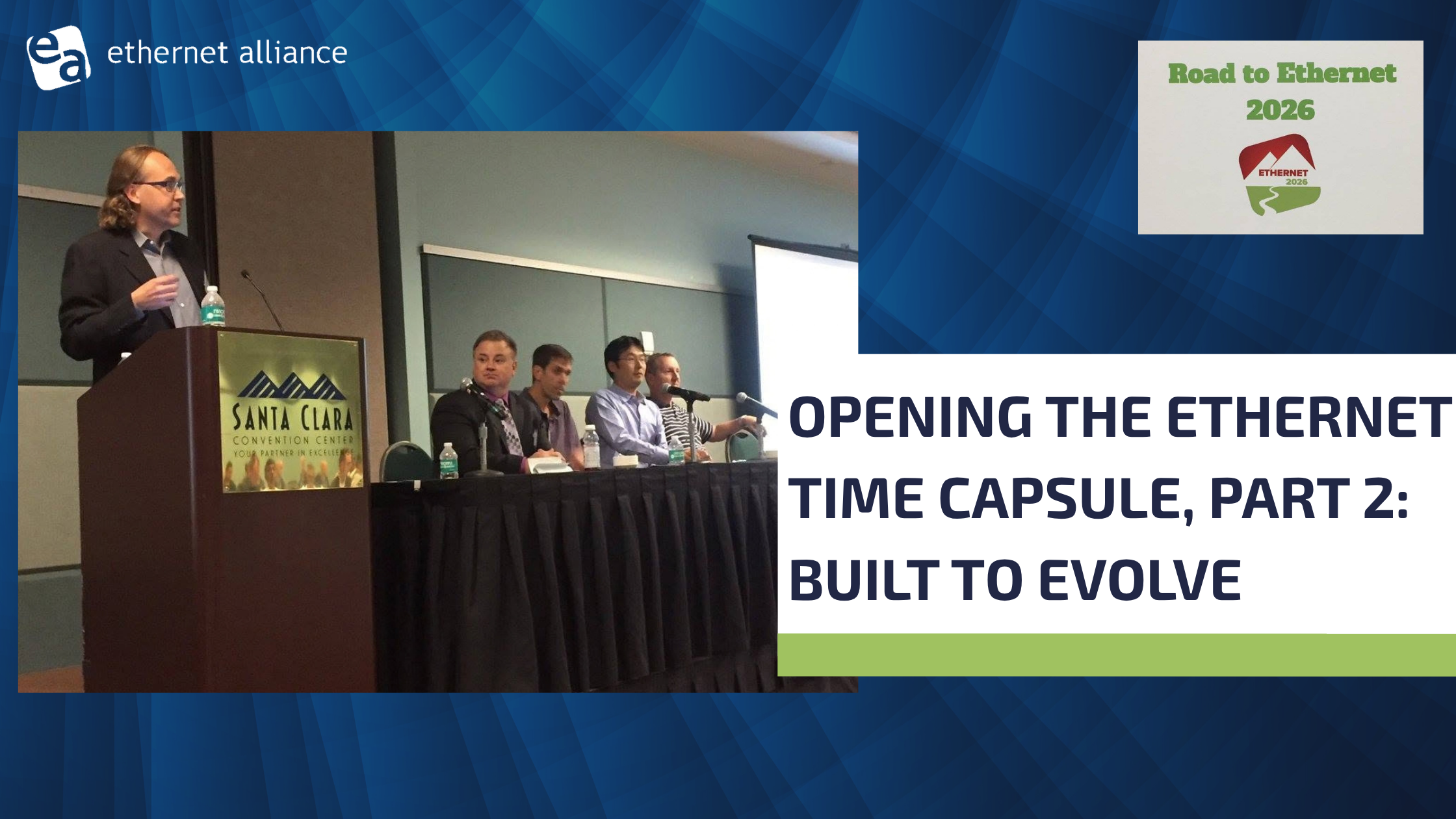
Opening the Ethernet Time Capsule: Looking Back at TEF 2016, Ten Years Later

Ten years ago, 2026 was the future for Ethernet.
At the Ethernet Alliance’s 2016 Technology Exploration Forum (TEF 2016), the industry’s flagship event for exploring the future of Ethernet, that future was the topic of conversation. Under the theme “The Road to Ethernet 2026,” speakers looked ahead ten years, considering everything from the relentless push for higher speeds to new applications, emerging technologies, and the challenges Ethernet would face along the way.
Ten years later, that future is now.
That gives us a rare opportunity to open the Ethernet time capsule and compare the view from 2016 with the reality of 2026. We asked three of the original TEF 2016 speakers, John D’Ambrosia, David J. Rodgers, and George Zimmerman, to go back in time and reflect on what they got right, what changed along the way, and what surprised them most.
As it turns out, quite a bit of the roadmap still looks familiar. The speed of the journey? Well, that’s a different story.
The Need for Speed? They Weren’t Kidding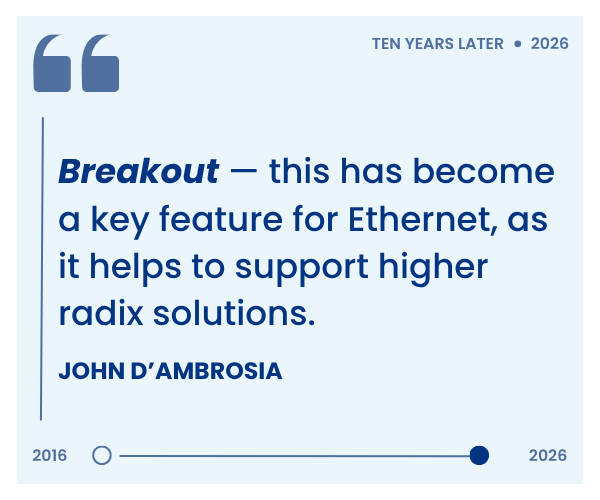
John D’Ambrosia’s 2016 presentation was called The Journey to “Higher Speed.” A decade later, those quotation marks around “Higher Speed” may be the most interesting part, because what counts as fast never stays fast for long.
The presentation looked beyond the question of just how fast Ethernet could go. Breakout, for example, allows a higher-rate interface to support multiple lower-rate connections. Ten years later, John points to it as one of the ideas that proved especially important.
And that wasn’t the only idea from 2016 that has held up. Another is deceptively simple: “Higher Speed” is relative.
Today, the drive toward higher-radix architectures has put increasing emphasis on lane rate. Higher lane rates can provide “higher speed” on a single-lane basis while also serving as the building blocks for higher aggregate Ethernet rates. And that brings us right back to those quotation marks.
“Higher Speed” was never really a destination. Ten years down the road, Ethernet is still on the journey.
A Smarter Road
David J. Rodgers was watching that same journey from a different vantage point.
His 2016 presentation, Ethernet Test & Measurement — “Paving the Road,” looked at what all that additional speed would demand from the technology supporting it. NRZ was giving way to PAM4, 50GE single SerDes was on the horizon, and the Ethernet “highway” was already pointing toward 200, 400, and even 800GE.
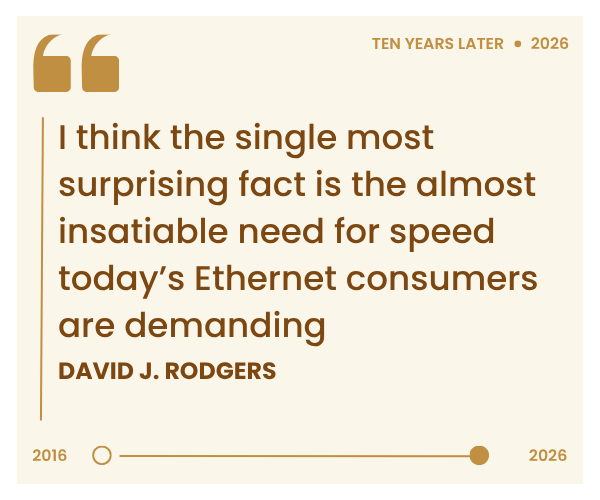 Pretty ambitious for a ten-year-old presentation. But ask David what surprised him most about the decade that followed, and the answer isn’t that Ethernet got fast. It’s how much faster everyone keeps wanting it to go.
He notes that in some cases, Ethernet speeds are now outpacing supporting serial interfaces like PCIe. Ethernet doesn’t operate in isolation, though. No matter how fast it can go, the rest of the computing ecosystem has to be able to keep up.
That almost insatiable appetite for speed has had consequences beyond the numbers. Back in 2016, David was already thinking about what faster Ethernet would demand from the technology around it. As speeds increased, the road itself would have to get smarter. His presentation elegantly summed it up in five words: “The ‘Road’ must be ‘smart.’”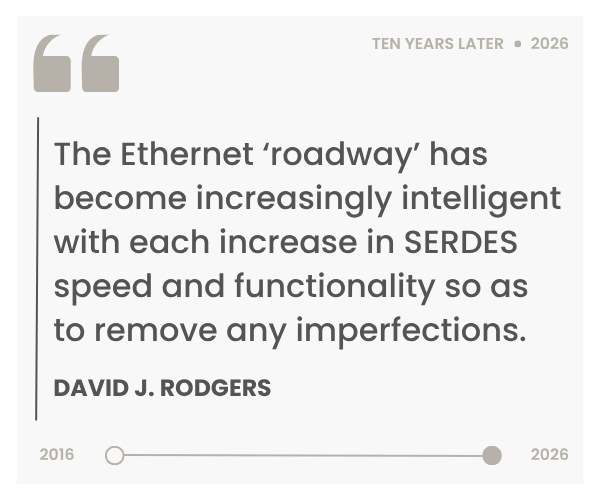
Playing Nicely Together
Fast-forward ten years, and David sees that smarter road as very much a reality.
But a smarter road comes with its own speedbumps. The more complex Ethernet becomes, the more important it is to make sure everything actually plays nicely together. David was thinking about that back in 2016, too. He memorably called interoperability testing the “NTSB” of the Ethernet ecosystem, a way to find the trouble spots when new technologies collide in the real world.
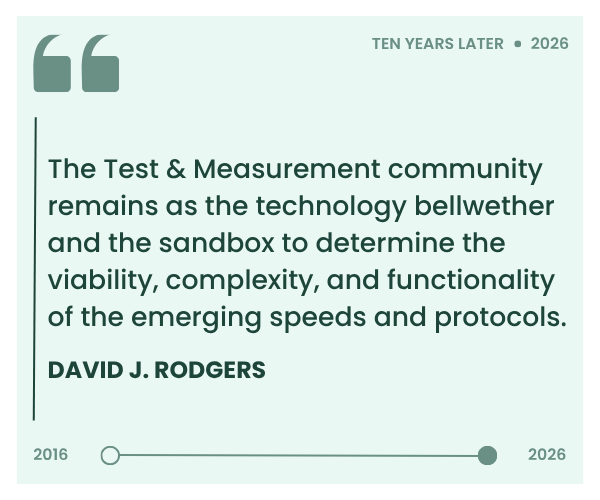 And there are a lot more players helping to make that happen today. David points to the growth of consortia and industry groups over the past decade, which he says has “fundamentally altered the interop landscape.” The names and numbers may have changed, but the goal is the same: make sure new technologies work together and get them into use.
Test and measurement has been there through all of it. Back in 2016, David called T&M vendors an industry “bellwether,” noting that their tools were evolving as quickly as the specifications themselves. Ten years later, he still sees them out in front.
Some ideas from a ten-year-old time capsule apparently don’t age.
The Future Was Just Getting Started
But speed was never the whole story.
The Ethernet of 2026 isn’t merely faster than the Ethernet of 2016. It has made its way into new places, taken on new jobs, and reinvented itself to meet demands that were only a twinkle in some engineer’s eye back then.
And then, of course, came AI.
Looking back, many of the industry’s predictions about high-speed Ethernet, interoperability, and network evolution proved remarkably accurate, even if the pace of change surprised everyone.
In Part 2, we’ll reach back into the time capsule with George Zimmerman, revisit what all three speakers saw coming, and look at what even a ten-year roadmap couldn’t fully anticipate.