OFC 2026: The Tech Leads’ Perspective

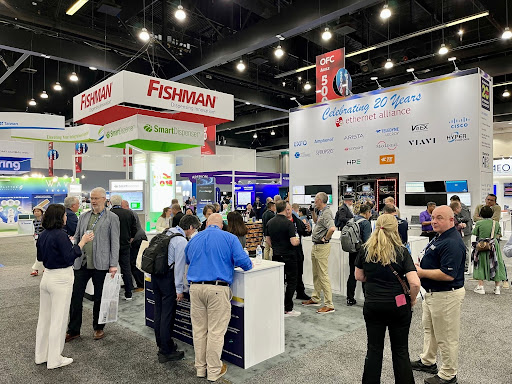
The Ethernet Alliance’s interoperability demonstration at OFC 2026 wasn’t just about the latest high-speed Ethernet advances. It reflected an industry that is rapidly evolving to meet the growing demands of AI, scale-out infrastructure, and increasingly complex multivendor networking environments.
We asked some of our OFC 2026 tech leads to weigh in with their thoughts on this year’s demo, AI-scale networking, ecosystem collaboration, and the technologies helping shape the future of Ethernet. Read on for a behind-the-scenes look at the innovations, challenges, and industry momentum that defined this year’s event.
Q: What did this year’s Ethernet Alliance OFC interoperability demo reveal about where the industry is headed?
Showcasing interoperability with the Ethernet Alliance at OFC was a challenging yet rewarding – and ultimately essential – part of the demo. Every year, new technologies emerge in response to the industry’s changing demands. But no matter how advanced those technologies are, their real value comes from being able to successfully coexist within diverse, multivendor networking environments. Without interoperability, the broader impact of these innovations becomes far more limited. – Tim Crawley, Product Marketing Engineer, VeEX
What stood out most to me is just how quickly the industry can coalesce around a shared goal when the challenge is important enough. In only four months, more than 14 leading companies came together to design and deliver a unified interoperability platform spanning interconnects, switches, and test equipment. OFC reinforced what the Ethernet Alliance continues to demonstrate year after year: when the ecosystem works together, Ethernet innovation scales quickly and reliably. – Vijay Murthy, Senior Solutions Architect, Keysight
My biggest takeaway from OFC is how closely our multivendor demo configurations and testing processes mirrored real-world interop testing.
As an integral partner within the test and measurement community, VeEX routinely supports customer interoperability and compatibility testing across data centers, NEMs, carriers, and operators. The multivendor validation across routers, switches, and interconnects reflects the same rigor the Ethernet Alliance applies when planning, building, and validating its OFC demos. That alignment speaks volumes about the maturity, readiness, and credibility of the equipment and technologies showcased at the event. – Keith Cole, GM & VP of Product Marketing – NEMs, VeEX
What was most striking was how quickly the ecosystem is rallying around emerging technologies. During our first OFC demos featuring 400GbE, it was tough to find 400G optics, and only a handful of hosts supported them.
Fast-forward to 2026 and our first year showcasing 1.6T, and more than half of our participating members brought either hosts or optics supporting 1.6T. That rapid acceleration is helping prepare the Ethernet ecosystem for the growing demands of AI. – Dave Estes, Senior Hardware Engineer, Viavi Solutions
Q: What role did you play in bringing the demo together, and what did people get to see?
For my part, I was responsible for setting up connections ranging from 800GE to 10GE. These links didn’t involve 224G/lane interconnects, ZR/ZR+ optics, or AI traffic; rather, they focused on standard Ethernet traffic using “gray” optics. While this portion of the demo didn’t necessarily showcase the industry’s flashiest new technologies, it highlighted something important: the interoperability and connectivity solutions that are the workhorses of today’s networks. – Tim Crawley
I was the Tech Lead for the Ethernet for AI demo, which explored how Ethernet and modern transport protocols can support the performance-intensive characteristics of AI/ML traffic. The demo showed that Ethernet can reliably deliver the high throughput, low latency, resilience, and congestion responsiveness required for bursty workloads. It reinforces how a technology with more than 50 years of history behind it continues to evolve for next-generation data centers. – Vijay Murthy
I focused on comprehensive 800/400/200/100/25/10G configurations spanning gray optics, LPO, and DAC/AOC interconnects. The demo encompassed an array of form factors, including OSFP800, QSFP‑DD800, QSFP‑DD, QSFP28, SFP‑DD112, SFP112, and SFP28/SFP+. Across these formats, gray optics, DAC, and AOC interconnects were exercised, alongside PMD variants like LR, FR, DR, and SR. Together, that breadth of speeds, form factors, and interconnect technologies underscored the real-world relevance of multivendor interoperability. – Keith Cole
I headed up the 200G/lane demos and overall interoperability diagram. The demo featured 200G/lane optics connecting a 1.6T switch to multiple pieces of test and measurement equipment, as well as a 200G/lane BERT and an evaluation board with 200G/lane co-packaged optics. It was a tangible display of how the entire ecosystem can work together seamlessly. – Dave Estes
Q: How did the 2026 interoperability demo bring AI-scale Ethernet innovations to life?
Demonstrating interoperability in conjunction with simulated AI workloads showed off Ethernet’s flexibility while emphasizing the critical role of interconnection. Multivendor interoperability was put on display using stateful RDMA over converged Ethernet (RoCEv2) traffic, as switches balanced intelligent routing with simultaneous non-AI traffic handling and KP4-FEC error injection across the network. It also highlighted the importance of priority flow control (PFC) and explicit congestion notification (ECN) in enabling the low-latency, lossless performance that is key for large-scale AI infrastructures. – Tim Crawley
The 2026 demo illustrated how the industry is adapting infrastructure to meet AI’s growing performance and power demands. As GPU clusters consume a larger share of data center power, network efficiency becomes increasingly important. By combining Ethernet, modern transport protocols, and Linear Pluggable Optics (LPO), it outlined the path toward a high-performance, lower-power, loss-aware fabric that is better suited for large-scale AI/ML deployments. – Vijay Murthy
This year’s demo presented innovations aimed at supporting the evolving demands of AI workloads. The exhibit brought together advances in switches, interconnects, and traffic generators enabling 1.6T Ethernet. Additionally, it incorporated 800G and 400G technologies, and low‑latency LPO interconnects and RoCEv2 traffic as part of our 800G AI showcase. Together, it reinforced how Ethernet continues advancing to support greater scale, efficiency, and interoperability. – Keith Cole
Multiple innovations on display addressed the demands of AI, including 1.6T ports/optics, RoCEv2, and lossless links created with PFC and ECN. These technologies contributed to more consistent network behavior in environments handling massive volumes of AI-driven traffic. – Dave Estes
Q: Why does multivendor interoperability matter now more than ever?
In real-world deployments, networks routinely combine equipment like transceivers, switches, routers, and test and measurement solutions from multiple suppliers. By showcasing true multivendor interoperability via the Ethernet Alliance demo, the industry not only reinforces the standards and specifications shaping Ethernet’s evolution, but also helps address the interoperability challenges engineers encounter every day. – Tim Crawley
Multivendor interoperability is essential because data center operators need confidence that components from different suppliers will work together seamlessly from day one. Standards bodies such as IEEE and OIF provide the technical foundation, while the Ethernet Alliance helps bring those standards to life through interoperability demonstrations, testing, and industry roadmaps. This collaboration reduces risk, accelerates deployment, and strengthens the ecosystem as a whole. – Vijay Murthy
The rise of open and multivendor system solutions, combined with the accelerated adoption of emerging technologies, has positioned multivendor interoperability as a critical enabler for success. Effective interoperability smoothes out equipment deployment and configuration, shortening the installation cycle, accelerating time to service, and minimizing ongoing support challenges. Spotting and resolving issues during development is also far more cost‑effective than addressing them after deployment. – Keith Cole
Multivendor interoperability is important because it proves the technologies are truly ready for real-world deployment and adoption. It also underscores the maturity of both the technology and the ecosystem by demonstrating that diverse products from multiple vendors can operate together consistently and reliably. – Dave Estes
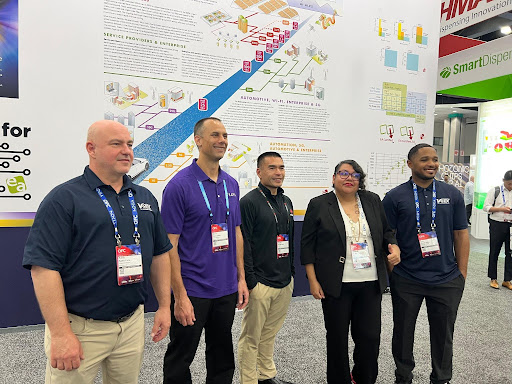
Q: Any final thoughts on your OFC experience?
There’s tremendous value in attending OFC, with so much to learn from the presentations and short courses, and exhibition booths. But participating as an exhibitor, especially through an industry-leading organization like the Ethernet Alliance, takes the experience to an entirely different level. I’ve thoroughly enjoyed the opportunity to learn from and build relationships with everyone involved in the Ethernet Alliance interop demo.– Tim Crawley
OFC is always a valuable chance to see how quickly the industry is advancing and to engage directly with the people driving that progress. The conversations, panels, and demonstrations offer practical insight into emerging trends and real-world challenges. Participating at the Ethernet Alliance booth was particularly rewarding, as it left me energized to help build an even stronger interoperability display and story for next year. – Vijay Murthy
It was encouraging to see increased attendance at OFC this year, as well as the continued emphasis on interoperability testing and broader industry participation. It was also enlightening to witness the wide spectrum of technologies on display, particularly the latest advancements in CPO, NPO, XPO, pluggable coherent optics, and the liquid‑cooling solutions being developed to address industry challenges. – Keith Cole
The Ethernet Alliance at OFC always means a great show, and 2026 was one for the record books. Thank you to all of the member companies that made the demo possible! That level of cross-industry support, collaboration, and cooperation remains one of the Ethernet ecosystem’s greatest strengths. – Dave Estes