Opening the Ethernet Time Capsule, Part 2: Built to Evolve

Ten years can change a lot in technology. Speeds climb. Applications emerge. Entire markets take shape around needs that were only beginning to come into view a decade earlier. But sometimes, looking back reveals something equally interesting: how much can change without starting over.
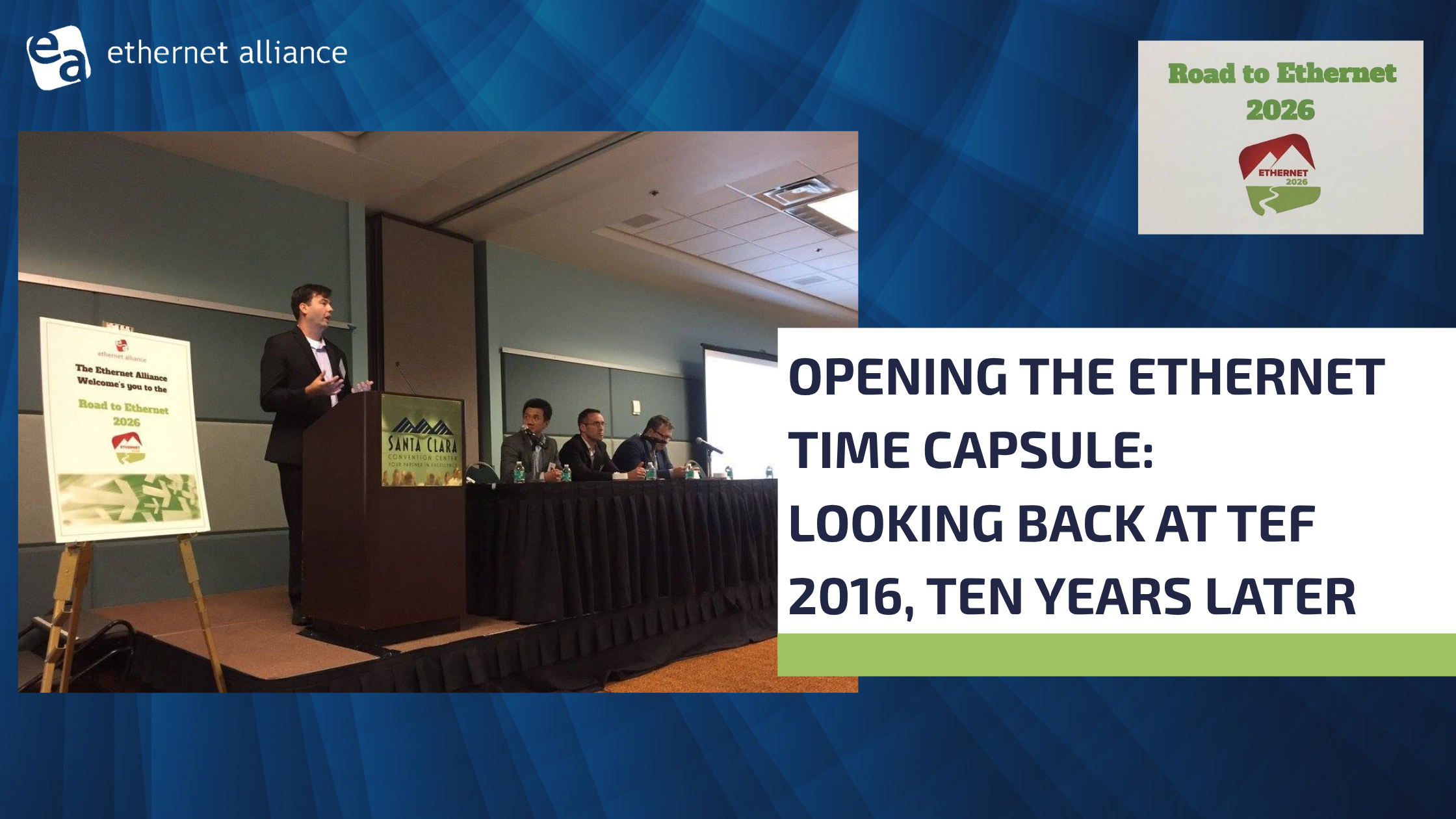
That was Ethernet Alliance’s Technical Committee Chair George Zimmerman’s perspective at the 2016 Technology Exploration Forum (TEF 2016). Looking back a decade later, he sees a story that isn’t simply about how far Ethernet has come. It’s also about what didn’t have to change, and all the new places Ethernet found to go from there.
Knowing What You’ve Got
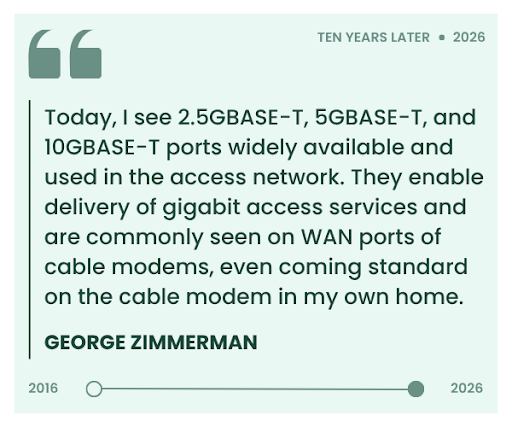 Fast-forward 10 years, and George doesn’t have to look far to see how some of his 2016 expectations played out. In fact, one example is sitting in his own home – a cable modem with a multigigabit Ethernet port.
And it doesn’t stop at the cable modem. The same story is playing out across multigigabit networks, with category cabling delivering both connectivity and power for wireless access. Enterprise switches have kept pace, too. The capabilities George was talking about in 2016 are now simply part of the landscape.
There’s something to be said for knowing what you’ve got. Moving forward doesn’t always mean replacing what came before. What Ethernet already had, as it turns out, had plenty of room to grow.
Ethernet Expands Its Reach
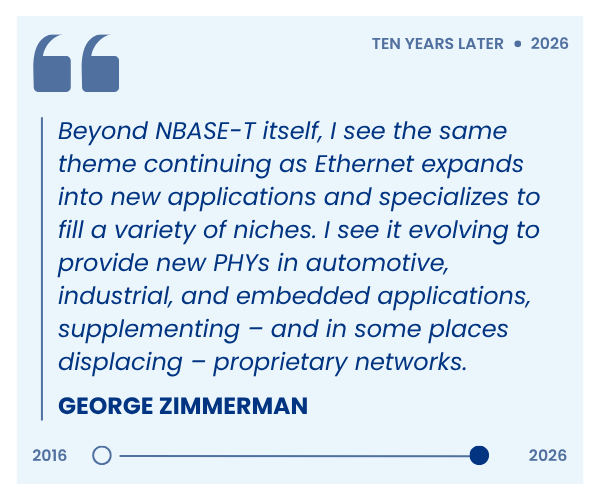
Ethernet didn’t just find more room to grow in familiar places. It found new places to go, too. For George, that may be the bigger story of the past decade. Ethernet has continued to branch out, evolving for applications that look very different from the networks he was talking about in 2016.
Every new job asks something a little different of Ethernet. That has included time-sensitive networking, new approaches to power delivery, and even a return to Ethernet’s roots in shared media. It’s also being shaped by the need for lower latency and the demands of machine-learning and machine-to-machine control. Today, its reach extends from industrial networking to specialized AI scale-up and scale-out networks.
The applications have changed. The pattern hasn’t.
Predictions That Still Hold Up
When opening a ten-year-old technology time capsule, you might expect to find a few ideas that haven’t aged particularly well. What’s more interesting about TEF 2016 is how familiar some of the ideas that once looked far out on the horizon feel today.
The speeds have changed. The applications have multiplied. And AI has gone from being among the “new applications emerging” to a force profoundly reshaping network requirements and the pace of innovation itself. But look past the numbers and acronyms, and many of the conversations from 2016 are still going on today.
Look back at what John, David, and George were talking about in 2016, and the connections are hard to miss. John D’Ambrosia saw “higher speed” as relative and new applications continuing to emerge. David Rodgers pictured an increasingly intelligent Ethernet “roadway,” with interoperability still essential to making it all work. George Zimmerman saw that Ethernet still had plenty of mileage in it, even as it headed out into new territory.
Ten years later, those ideas feel less like separate predictions and more like different parts of the same story.
And maybe that’s what the time capsule got most right. There was never going to be one speed, one application, or one technological leap that defined what came next. Ethernet would keep evolving because the world would keep finding new things to ask of it.
In 2016, the Ethernet community was looking ahead and wondering what the next ten years might bring. Now, in 2026, we get to look back at some of the answers. But there’s something fun about a time capsule: eventually, today becomes the thing we look back on.
The questions we’re asking now, the problems we’re trying to solve, and the ideas that feel new in 2026 will someday tell their own story about where Ethernet went next.
The time capsule is open, and the next chapter is already being written