Wired for What’s Next: Presentations and Highlights from TEF 2026

 AI is changing the networking landscape, and it’s not exactly taking its time. If one thing was clear at our 2026 Technology Exploration Forum – The AI Future: Ethernet (TEF 2026), it’s that Ethernet isn’t standing still. And neither is the industry behind it.
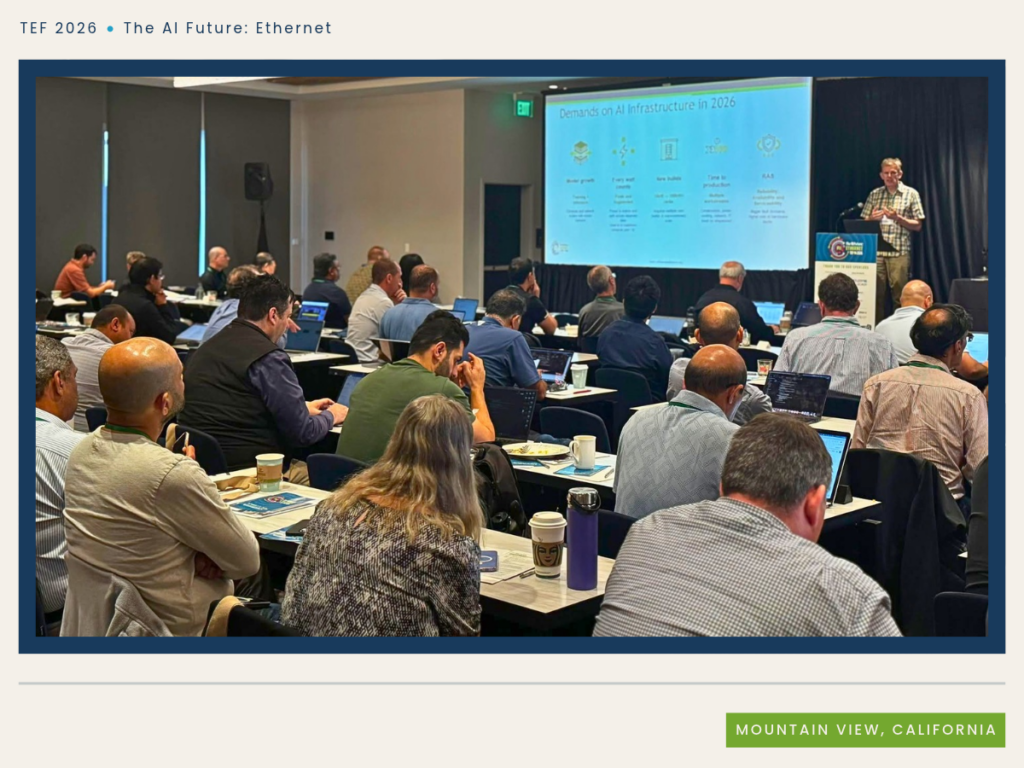
In October 2026, we brought together analysts, researchers, technology developers, and industry experts in Mountain View, California, for two days of candid conversations about the technologies and challenges shaping Ethernet’s AI future.
There was an abundance of big ideas, thoughtful questions, and spirited discussions. With so much happening across the Ethernet ecosystem, two days barely seemed like enough time to cover it all. Luckily, the conversations don’t have to end just because TEF 2026 has wrapped up.
Whether you joined us in Mountain View or couldn’t make the trip, the TEF 2026 presentations are now available to download. Explore the full collection here: https://bit.ly/EA-TEF26Presentations
So, what was everyone talking about, anyway? Quite a bit, actually. From the sheer speed of AI-driven demand to the hurdles of making 400G a reality, TEF 2026 speakers had plenty to say about where Ethernet is headed and what it’ll take to get there. Here are a few takeaways worth sharing.
AI Demand: Off the Charts
There’s fast, and then there’s AI fast.
According to 650 Group’s Alan Weckel, AI is reshaping the networking market at a staggering pace. With scale-up, scale-out, and scale-across networks expanding the market beyond traditional networking, demand is reaching some pretty remarkable levels.
How remarkable? Alan noted that some vendors experienced “single orders in CY26 that were larger than their total original forecasts.”
Let that sink in for a second, because this is where things get particularly interesting. As the first signaling speed to fully experience AI-driven demand, 400G electrical isn’t just about pushing performance forward. It’s about keeping up with a market that’s changing the rules as it goes.
400G Gets Real
Meeting that kind of demand means more than “just go faster.”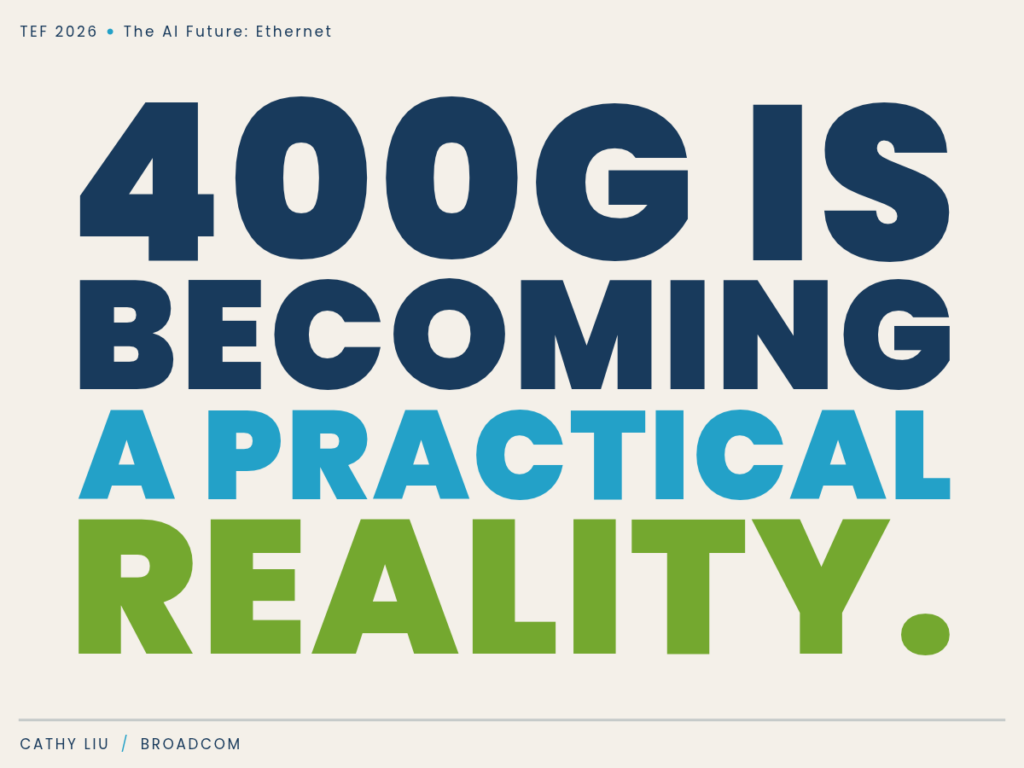
As Broadcom’s Cathy Liu pointed out, “400G requires a holistic shift in system design.” That’s no small undertaking, but there’s good news coming out of the labs. The research and development shared at TEF 2026 showed that the industry is making real headway.
The really exciting part, though? As Cathy put it, “400G is becoming a practical reality.”
There’s still work to be done, of course. But as the technology moves forward, so does the need to make sure the broader Ethernet ecosystem is ready to support it.
Raising the Standards
Getting the technology there is one thing. Making sure the standards can keep up? That’s another.
As Terahop’s Rang-Chen Yu reminded attendees, Ethernet standards have served cloud and AI computing well for decades. However, AI has thrown quite a few new wrinkles into the mix, and keeping Ethernet standards moving forward is more important than ever. As he put it, “Ethernet standards need to continue to advance at much higher velocity.”
That’s a tall order, especially as the industry works through the complexities of next-gen 400G-per-lane technology. But it’s also where collaboration really counts. If the discussions at TEF 2026 were any indication, there’s no shortage of people ready to roll up their sleeves and make it happen.
Through the Ethernet Looking Glass
One of our favorite things about TEF 2026 was the diverse mix of people in the room. Where else can analysts, end users, equipment providers, and technology developers come together to examine the same challenges from so many different angles?
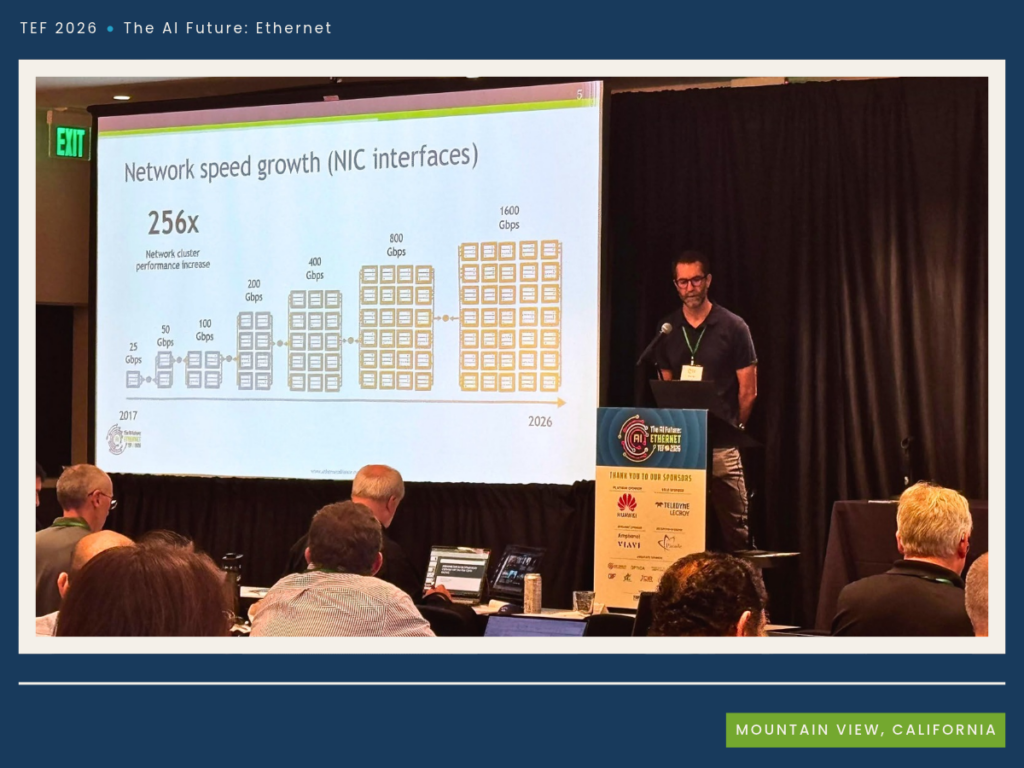 For first-time attendee Eric Manilof of Ciena, that mix made for some especially interesting conversations. With demand for faster, denser interconnects taking off, he was particularly interested in opportunities to increase transmission rates using both IMDD and coherent technologies. Hearing from analysts just how quickly the market for AI data center connectivity is growing was, according to Eric, “an excellent take-home message.”
Putting It All to the Test
Faster interconnects are only part of the story. For VIAVI’s Paul Brooks, one of the biggest TEF 2026 takeaways was how AI is reshaping nearly every part of he Ethernet ecosystem, from 400G-per-lane signal integrity to the infrastructure demands of gigascale data centers.
With so many moving parts, test and measurement has its work cut out for it. As Paul noted, “As speeds and scale accelerate together, test and measurement will play a critical role in enabling the next generation of AI Ethernet.”
That means supporting what he calls “the full ecosystem lifecycle,” from R&D labs developing 400G SerDes and IP to pluggable optics and fiber hygiene at massive scale.
The Road Ahead: No Shortcuts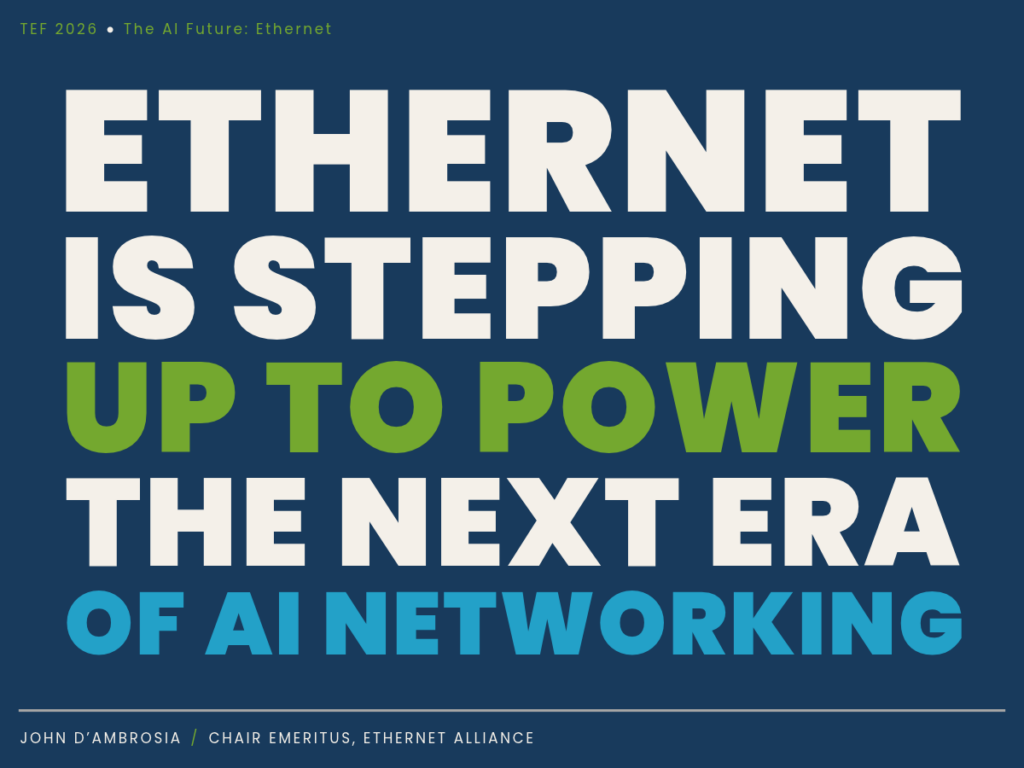
So, where does that leave us? With an ever-growing task list. From rising bandwidth demands to optical scaling and fiber congestion, the challenges aren’t getting any smaller. Yet there’s good reason for optimism.
As John D’Ambrosia said, “Ethernet is stepping up to power the next era of AI networking,” and the engagement and technical momentum at TEF 2026 reflected the industry’s confidence in its ability to meet those demands.
The conversations may have wrapped up in Mountain View, but the work certainly hasn’t. We’re looking forward to seeing how the ideas and technologies discussed at TEF 2026 take shape in the months ahead.
Ready to dive deeper? Download the TEF 2026 presentations and explore the ideas, technologies, and discussions shaping Ethernet’s AI future.